
 Deutsch
 English

Certificate in Higher Education Pedagogy PLUS
The University Didactics PLUS Certificate builds upon the University Didactics Certificate and is designed to help participants develop their individual professional profiles and apply what they have learned to their own teaching. The program focuses on the planning, implementation, and documentation of a personal teaching project. Participants are expected to carry out this teaching project by selecting additional workshops and taking advantage of various advisory services.
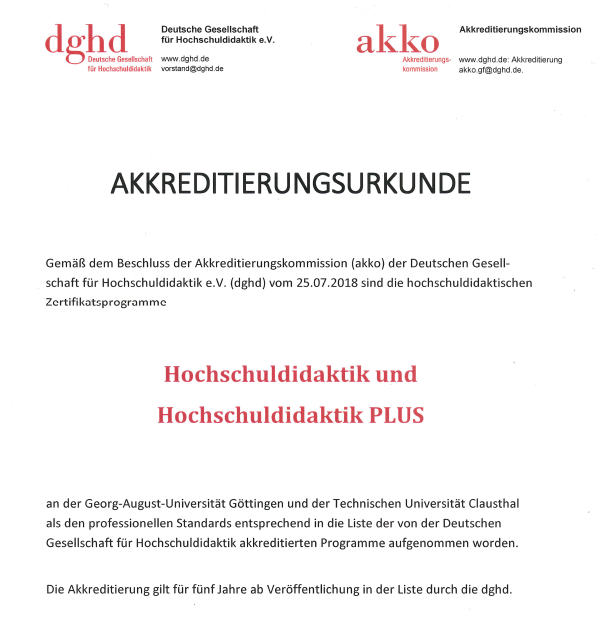
The University Didactics PLUS certificate program is conducted in cooperation with the Department of University Didactics at Georg-August-Universität Göttingen and, pursuant to the decision of the Accreditation Commission (akko) of the German Society for University Didactics e. V. (dghd) dated April 17, 2025, as meeting professional standards and has been included in the list of programs accredited by the dghd (Accreditation Certificate).
The Certificate in Higher Education Didactics PLUS includes the modules of the Certificate in Higher Education Didactics and an additional advanced module that can be started after completing the Certificate in Higher Education Didactics. Unlike the Certificate in Higher Education Didactics, which is completed in a fixed group, the advanced module is designed to be more flexible and tailored to individual needs. In total, the advanced module comprises 80 credit units (AU).
Registration for the Certificate in Higher Education Didactics PLUS is available via our registration form. After successful registration, the advanced module begins with a consultation at the ZHD regarding a potential teaching project. The individual focus of the advanced module is then determined jointly. The advanced module generally consists of the following components:
A workshop in Competency Area F "Leading and Managing Groups" (12 CEUs)
Competency Area F focuses on group communication and group dynamic processes in teaching. In addition, the leadership of junior research groups, tutor groups, project teams, and staff management may also be addressed. Workshops from this competency area can be found in the open workshop program of the ZHD at Clausthal University of Technology or the Department of University Didactics at the University of Göttingen.
Peer practice discussion (4 credit units)
In the advanced module, participants attend another practical discussion, which is reserved as much as possible for participants in the Certificate in University Didactics PLUS and which focuses, among other things, on the implementation and execution of the teaching project.
Expert Observation (6 credit units)
Individual feedback on teaching practices is continued in the advanced module through an expert observation conducted by a staff member from the ZHD. At the participants’ request, the observation can be supplemented by a video recording of the selected session or course phase, thereby adding another perspective to the feedback and the view of the teaching. The students’ perspective is also gathered during this observation, enabling comprehensive feedback. The observation session is to take place as part of the teaching project concluding the program.
Elective Workshops (16 credit units)
To develop their individual profiles, participants are required to complete workshops from the open workshop program totaling at least 16 credit hours. During the initial consultation, workshops that are particularly suitable and helpful for carrying out the teaching project will be recommended.
Teaching Project (42 credit hours)
The transfer to one’s own teaching practice is facilitated in particular by a teaching project that concludes the certificate program. Participants develop an innovative teaching concept and are advised and supported in this process by a ZHD staff member. The definition of the project context is the responsibility of the participants and can encompass a broad thematic scope. For example, the following areas are conceivable:
- New concepts for a course or a series of courses,
- e-learning scenarios,
- tutor/mentor programs, or
- (further) development of modules or degree programs.
A realistic and concrete plan for implementation should be developed. In addition to the conception, planning, and implementation of the project, the teaching project includes a written report that reflects on and documents the project. You can find a brief guide for this report at the following link.
Registration
Please sign up here : Registration
Accreditation
Contact & Service

ADDRESS & DIRECTIONS
Center for Higher Education Didactics
Arnold-Sommerfeld-Str. 6
38678 Clausthal-Zellerfeld
Rooms 211–215
Directions: Campus map, C9
CONTACT
Tel: +49 5323723054
Fax: +49 5323723059
Email: hochschuldidaktik@tu-clausthal.de